Leadership & Team Management
Build a team that survives every contributor. 5 years at Pichet (Technical Lead to Engineering Manager on the ESB perimeter), CEO/CTO at ACCENSEO since 2024, active CTO Craft cohort.
My definition
Engineering leadership, the way I define it, is the discipline that builds, grows, and aligns a team so that the system it ships outlives any single contributor. It covers hiring, mentoring, performance management, change management, and the day-to-day craft of facilitating decisions. It is not a title you carry on a business card: it is a posture that shows in the quality of the team you leave behind.
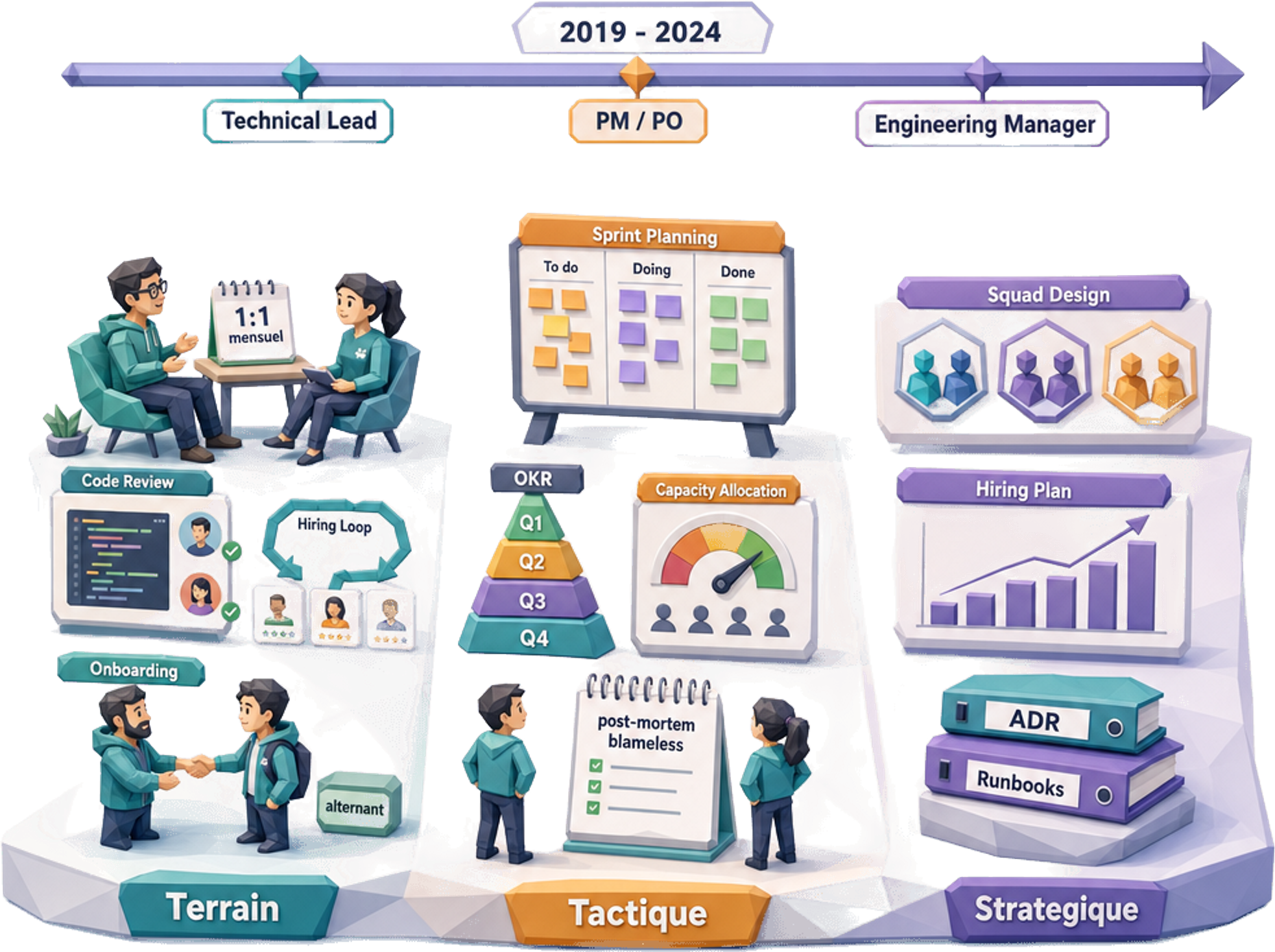
I run this competency on 3 simultaneous levels. Hands-on: monthly 1:1s, code reviews, recruiting loop, apprentice onboarding. Tactical: sprint planning, quarterly OKRs, capacity allocation, blameless post-mortems. Strategic: squad design, hiring plan, knowledge capitalisation through ADRs and runbooks. My evolution at Groupe Pichet (January 2019 to March 2024) took me from Technical Lead to Project Manager / Product Owner and finally to Engineering Manager on the ESB perimeter (October 2023 to March 2024). What I keep from it: my output is now my team's output, and a manager who stays on the technical critical path is a manager who blocks their team from growing.
In 2026, engineering leadership has become a major hiring differentiator on the CTO market. Remote-first teams, AI-assisted development, and shorter funding runways all demand managers who can compress the hire-to-autonomy cycle below 90 days, measure the Mean Time to Verification of an agent-generated PR, and orchestrate a mix of humans + AI agents in the same backlog. The Stack Overflow report How engineering teams can thrive in 2025 makes it explicit: engineering team success in 2025-2026 depends less on stack choice than on the manager's ability to design an organisation where autonomy, experimentation, and quality are wired in by default.
My evidence
Anecdote 1 : Growing the Pichet ESB integration team from 1 to 7
When I joined the ESB scope at Groupe Pichet in 2021, the integration team was hanging by a single thread: a sole owner, Jean-François, kept the entire Tibco BusinessWorks platform alive by himself, orchestrating more than 100 flows across 20 business applications - accounting ERP, treasury, hospitality PMS, PIM, DAM, marketing automation, IGA, HRIS, fleet management. 5 business directions ran on those flows and any outage cut accounting entries, CRM leads or pricing updates on the group's websites. On top of that, the SOFT Monitor system was firing 2,377 notifications a month into a shared mailbox, with a real alert fatigue burying critical failures under routine noise.
I rebuilt the team brick by brick. I created the Jira ESB workspace to centralize every integration ticket, kicked off the Confluence documentation (ERP flows, IGA flows, Soft Monitor guides), then in May 2022 I launched the Daily Enterprise Integration standup and the bi-weekly COPROJ with the business heads. From February 2023 onward, I rolled out a full Agile cycle (Sprint Planning, Sprint Review, Retrospective) tuned to middleware constraints. I drove the knowledge transfer with Jean-François across 10 dedicated sessions before his departure to avoid any service disruption, hired internally (Kalala M., Melissa B.) and assembled a mixed crew with Square IT and RS2I contractors (Issam J., Achraf L.), enforcing cross-company code reviews between insiders and partners to break vendor silos. In parallel, I sized and arbitrated 84 flow requests raised by 8 IT business teams - 65 retained, 19 deferred - while building the team's first cost-estimation model and managing a yearly envelope of roughly $370K.
The team grew from 1 to 7 engineers between 2021 and 2024, shipped more than 100 flows on 20 enterprise systems with a single-digit incident rate, and survived 4 consecutive CIO changes without losing momentum. The Bus Factor went from 1 to 4 on critical flows, and the documentation standards I introduced (DAA, DAT, DEX, DFX, per-flow runbooks) were adopted as the department reference.
Beyond the numbers, what I keep is the discipline that lets a team outlive its manager: radical candor in 1:1s, a decision journal before every check-in, hiring for trajectory rather than for the current job description. I run those same gestures today at ACCENSEO. My output is no longer the code I write - it is the autonomy of the team I leave behind.
Anecdote 2 : Recruiting and onboarding alternants at ACCENSEO
In September 2024 I started ACCENSEO as CEO/CTO with a clear budget constraint: to deliver several multi-sector clients in parallel without saturating my own days, I had to staff a small team fast - but without breaking the operating margin in the first year. The answer was the French alternance contract: hiring 2 developers and one project manager as work-study apprentices with a target of full autonomy in 3 months.
I built a recruiting funnel tailored to alternants - short technical exercise, posture interview, product-situation simulation - to filter motivation more than diploma. The first 2 weeks of each apprentice were dedicated to intensive pair-programming on the ACCENSEO codebases (the SaaS accounting platform and the internal tooling), with a written onboarding guide, progressive DEV then PROD access, and daily mentoring. From week 3 on, each apprentice owned a module end to end, with monthly code reviews and weekly objective check-ins. For the project manager, I duplicated the pattern on a real client engagement under mentorship, then released full autonomy once the project rituals were in place.
Within 3 months the 2 developers and the project manager were autonomous on their scope - able to frame a client request, deliver on their own, and run their own reviews. ACCENSEO's operating margin held because every apprentice took real product ownership from the first quarter, not a support role.
That experiment recalibrated the way I build a team: hire for the learning trajectory rather than for the current title, and accept that mentoring time is the highest-yield investment I can make at the early stage. It is the exact same logic I will replay in the next CTO scale-up role - a short hire-to-autonomy cycle is what separates a team that grows from a team that burns out.
My self-critique
I sit at a Confirmed trending Senior level. Coverage is complete on the recruiting / performance / change-management triptych, calibrated by 5 years and 3 months of evolution at Pichet (Lead Tech → PM/PO → Engineering Manager over the last 6 months), an MBA in Strategic Project Management, and almost 2 years running ACCENSEO. What still needs strengthening: actual time held in the Engineering Manager title, board-level English pitch under pressure, and the rapid 72-hour read of an organisation during a due-diligence audit.
It is the absolute pivot of my profile for the next 24 months. Every CTO scale-up search I analysed in 2025-2026 weighs leadership above stack or domain - without it, architecture does not deploy, strategy is not executed, security stays theoretical. In my current role, it is the lever that turns individual time into team capacity.
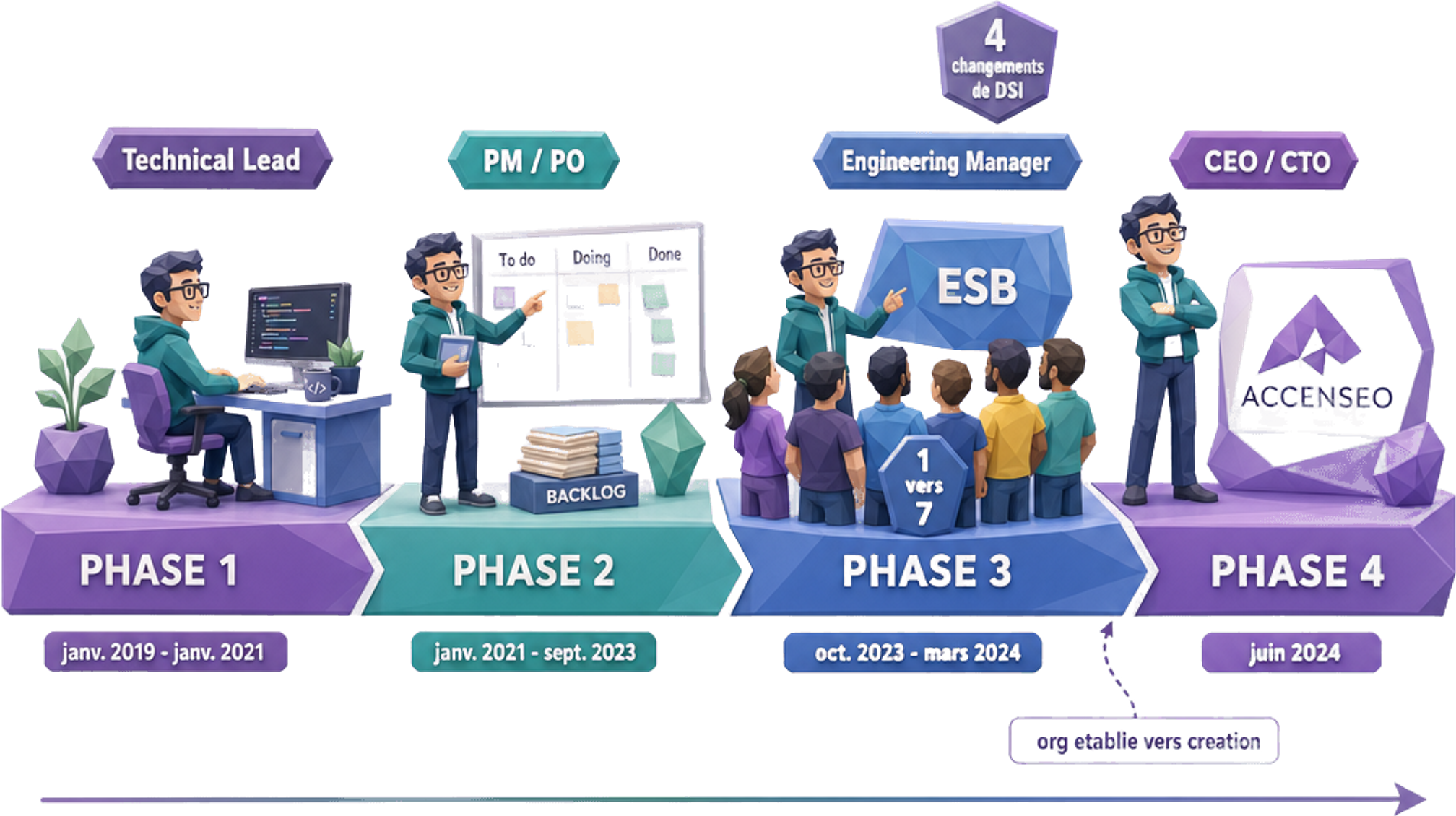
The Pichet trajectory unfolded in stages: Technical Lead (January 2019 to January 2021), Project Manager / Product Owner (January 2021 to September 2023), then Engineering Manager on the ESB perimeter (October 2023 to March 2024). The formal management title lasted only ~6 months, but the enterprise integration platform was carried throughout the cycle (team 1 → 7, surviving 4 consecutive CIO changes). The EM → CEO/CTO move at ACCENSEO in June 2024 confirmed the portability of the competency from an established org to a brand-new one.
My 4 reflexes I keep replaying since the move to a managerial posture at Pichet, and that I keep at ACCENSEO:
- practise radical candor, never optimise for being liked but for each member's growth
- keep a systematic 1:1 prep journal before every check-in - 30 minutes a week, the insight-to-time ratio is unbeatable
- hire for trajectory, not for the current job description
- capture every irreversible decision as an ADR to transfer the memory to the successor
My evolution in this skill
My 18-24 month plan
Leadership is what takes me from Engineering Manager to CTO at a 10-30 engineer SaaS B2B scale-up. Concretely: take over an existing product organization, redesign squads around revenue lines, run a 6 to 8 senior and mid hiring cycle the first year, and install a measurable delivery cadence. Without it, architecture, strategy and security do not transpose to team scale.
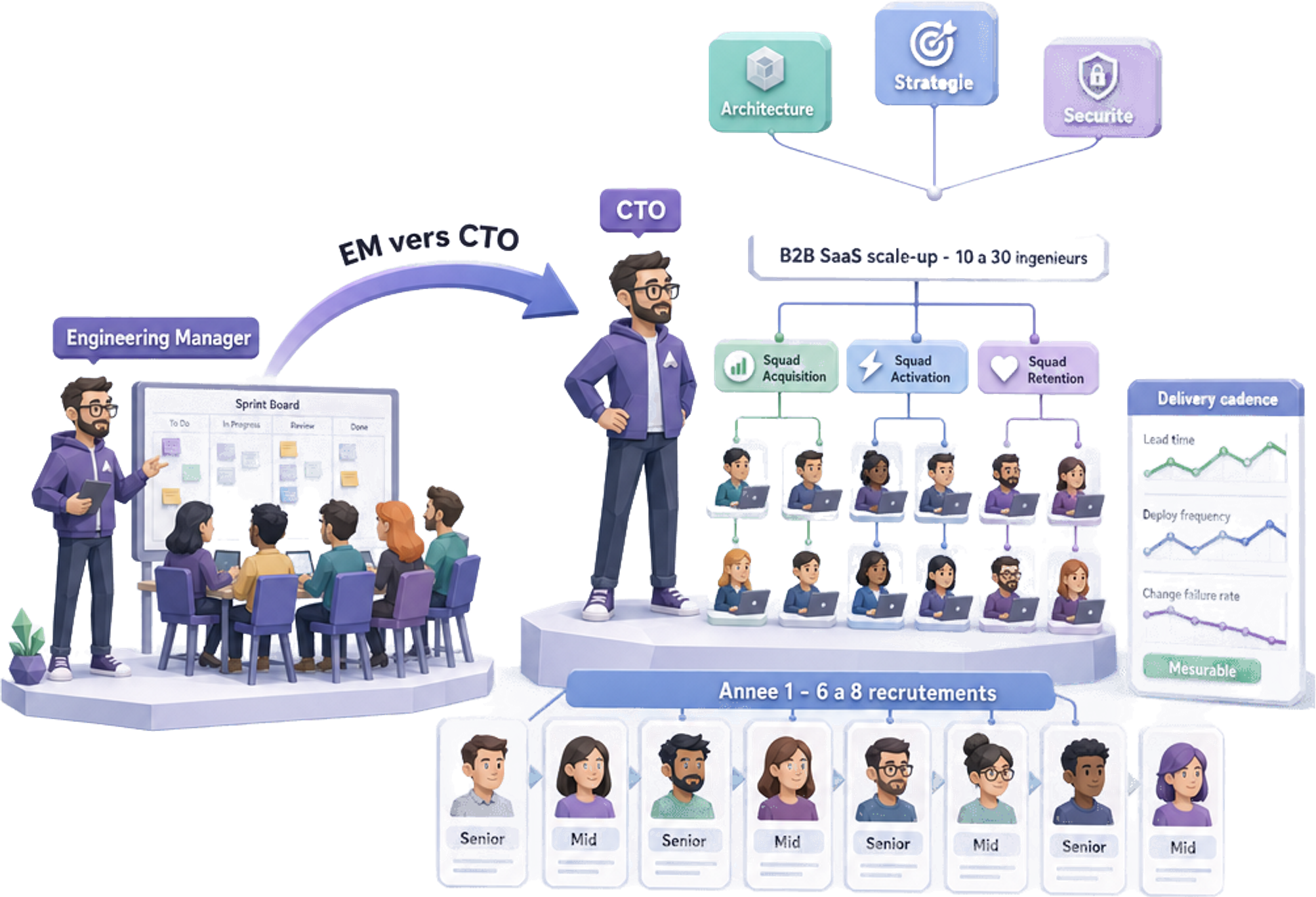
The level I aim for is operational and observable: take over a 10-30 engineer org, redesign its squads, hire and ramp a senior team, negotiate the technical P&L with the board, and install a peer-review culture in 6 to 12 months. Success indicator: internal NPS >= 50 and a hire-to-autonomy cycle under 90 days.
Monthly peer-coaching with 2 other scale-up CTOs (one B2B SaaS finance, one B2C marketplace), CTO Craft cohort followed monthly since September 2025, systematic 1:1 prep journal before every team meeting. Master in Software Engineering (active 2023-2026) and MBA Strategic Project Management (2023-2025) anchor the academic layer.
Executive program on organizational design and board-level communication planned 2026-2027, triggered when the CTO scale-up target lands. Senior salary and offer negotiation training before the first hiring wave. Advanced CTO Craft cohort targeted late 2027.
My readings and feedback loops
- annual reads of The Manager's Path (Fournier), An Elegant Puzzle and Staff Engineer's Path (Larson), High Output Management (Grove)
- annual 360 feedback round via former Pichet colleagues and ACCENSEO alternants
- weekly intake of scale-up engineering blogs: Lethain, Charity Majors, Lara Hogan